How “Big” Is a Brain?
The human brain contains approximately 86 billion neurons and roughly the same number of supporting cells, most of them glial cells. These neurons form hundreds of trillions of connections, creating an almost unimaginable number of possible patterns.
But how big are these numbers, really?
Let’s put them into perspective.

Imagine a Neuron
When we talk about the brain, we often hear the term brain cells. But the brain contains several different types of cells. The ones primarily responsible for processing and transmitting information are called neurons.
A neuron’s cell body is typically only a fraction of the width of a human hair, while its tiny extensions can be up to 100 times thinner.
Now imagine representing the cell body of each neuron with a small cube, measuring 1 × 1 × 1 centimetre.

A Thousand Neurons
Imagine placing ten of these small cubes in a row, then adding nine more rows to form a square of 10 × 10 cubes. Stack ten such layers on top of each other, and you have a total of 1,000 cubes forming a larger cube measuring 10 × 10 × 10 cm.

A Million Neurons
Now imagine repeating the process, but this time using 10 cm cubes, each containing 1,000 small dice. Arrange ten in a row, add nine more rows, and stack ten such layers on top of each other. You now have a cube measuring 1 × 1 × 1 metre, containing a total of one million small dice.

How Much Is a Billion?
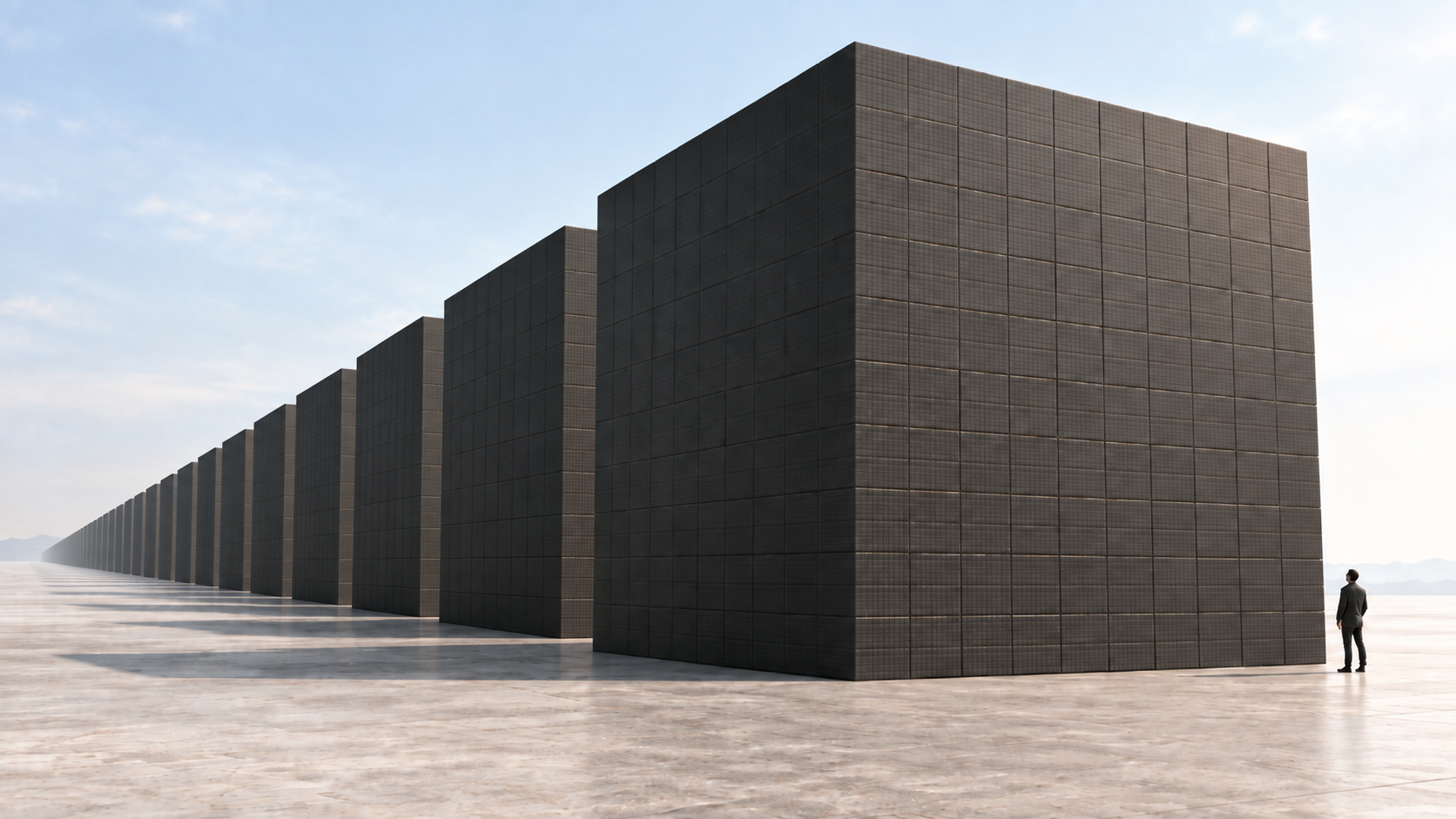
Now imagine repeating the process once more, this time using metre-sized cubes, each containing one million small dice. Arrange ten in a row, add nine more rows, and stack ten such layers on top of each other. You now have a cube measuring 10 × 10 × 10 metres, containing a total of one billion small dice.

So… How Big Is a Brain?
The human brain contains approximately 86 billion neurons. That means 86 of our giant cubes, each containing one billion small dice. Line them up with about a metre between each cube, and the row would stretch almost a kilometre!
But that’s not all. The brain also contains roughly 85 billion non-neuronal cells, most of which are glial cells that support, protect and maintain the neurons.
How Many Connections?
A connection between two neurons is called a synapse. The human brain is estimated to contain hundreds of trillions of synapses. To picture that, imagine repeating the same process again and again until you end up with a cube measuring 1 × 1 × 1 kilometre — a giant block containing 10¹⁵ small dice.

How Many Possible Patterns?
Imagine that each synapse could exist in just two states: on or off. The number of possible combinations would be almost unimaginable.
Estimated atoms in the observable universe: 10⁸⁰
Theoretical patterns in one human brain: up to 10³⁰⁰,⁰⁰⁰,⁰⁰⁰,⁰⁰⁰,⁰⁰⁰
This is a theoretical combinatorial illustration, not a literal model of how the brain works. But it gives us a sense of the extraordinary capacity of the human brain.
It is safe to say that, for practical purposes, the amount we can learn and remember is not primarily limited by the brain’s storage capacity.

The Real Challenge: Learning How to Learn
The real challenge lies in how effectively we encode, organise and retrieve what we learn.
And that is precisely what we explore and develop at Master Learners.
Learning involves both mind and body. Our brains do far more than store memories and generate thoughts. They also coordinate movement, control our bodies and enable us to develop practical skills.
Whether you are a thinker, a creator or a practitioner, our mission is the same: to help you become a master of learning.